**🇺🇸 MEMORIAL DAY SALE · $200 OFF PER CONTAINER · ENDS 5/25 · SHOP NOW!**


How are Shipping Containers Delivered?
Eveon offers three flexible delivery options to fit any site, any budget, and any timeline. From driveway drop-offs to precision retail placements, Eveon has you covered.

What To Expect With Your Container Delivery From Eveon
At Eveon Containers we partner with local, experienced, and fully insured truckers who provide best in class delivery services. Focused on convenience and efficiency, Eveon makes it easy to have your 20ft or 40ft container delivered exactly where you need it—quickly, safely and within 3-5 business days.
### Getting Your Container is Simple with These Easy Steps
1. **Choose Your Container & Delivery:** Pick the container size you need and the delivery method that works best for your site and access conditions.
2. **Confirm, Coordinate & Prepare:** Our team and the driver review the details, confirm the delivery window and answers any access or preparation questions upfront. Ensure the site, ground and area are ready.
3. **Container Arrives Onsite:** Your container is delivered safely and placed exactly where you need it — ready for immediate use.
### Three Delivery Options Becauce Every Site is Different
#### 1. Tiltbed Delivery ★ Most Popular
**The hassle-free drop-off for most sites.** A tiltbed (or tilt-deck) truck hydraulically angles its bed toward the ground, letting the container slide smoothly into position without any on-site crane or lifting equipment. It's the fastest and most affordable way to get your container placed.
- Best for residential driveways, backyards, and standard commercial lots
- No crane or forklift needed on your end
- Requires approximately 80–100 ft of clear, level run-out space in front of the placement spot
- Ground surface must be firm and reasonably level (gravel, concrete, asphalt, or compacted soil)
- Minimum 14 ft overhead clearance required along the approach path
#### 2. Flatbed Delivery
**Best when space is tight or access is limited.** A [flatbed truck](https://www.eveoncontainers.com/en-US/Everything-You-Need-to-Know-About-Flatbed-Delivery-for-Used-Containers) transports your container to the site, where it is lifted off using a crane or side-loader. This method gives you far more flexibility in placement — ideal for tight spaces, elevated positions, or when a tiltbed truck simply can't maneuver in.
- Ideal for sites with limited approach space
- Crane or side-loader equipment required at the destination (you must provide)
- Site must be accessible for the flatbed truck and the lift equipment
#### 3. Customer Pick Up ★ Best Value
**Take control and save on delivery costs.** If you have access to a suitable truck and trailer, picking up your container directly from our yard is the most cost-effective option. You handle the transport on your schedule, and we make sure the container is ready to load when you arrive.
- Lowest total cost because there's no added delivery fees
- Flexible timing — collect when it suits you
- Requires a semi-truck or appropriate tow vehicle with a compatible tilt or flatbed trailer
- Customer assumes responsibility for transport from our yard
- The depot yard team will assist with loading and securing
## Container Size & Site Location Matter
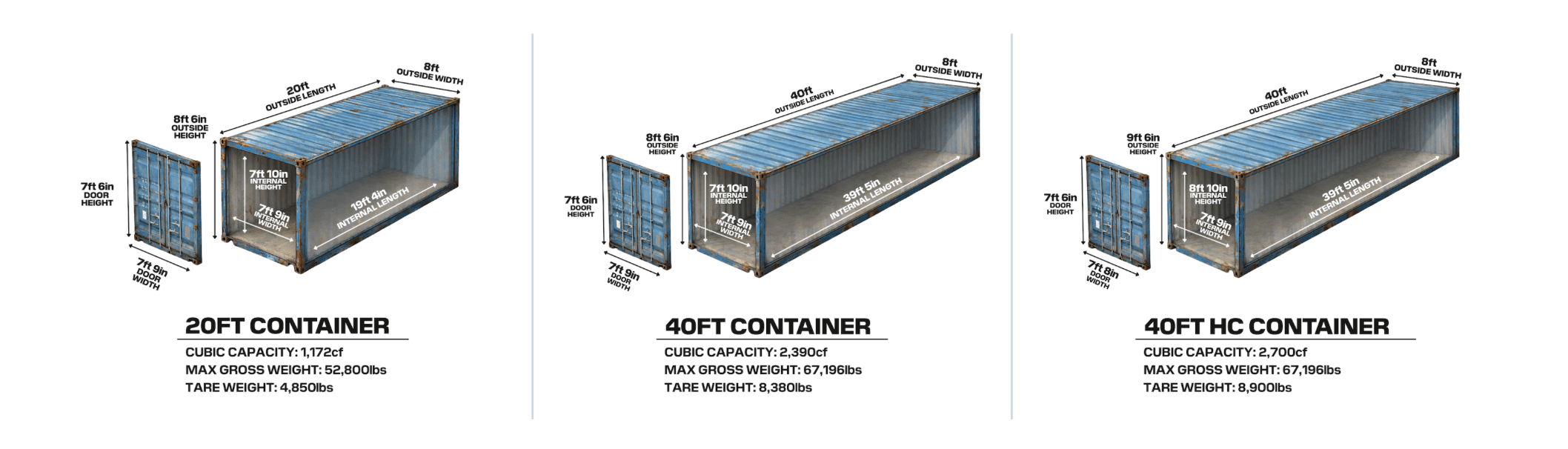
Before purchasing your container, consider the dimensions below to ensure your delivery site is big enough. Please review the [container delivery guide](https://static.eveoncontainers.com/strapi/assets/Delivery_guide_booklet_03a5bab11b.pdf) and watch the video below to be prepared for your carrier and to guarantee a seamless process.
Frequently asked questions about the delivery
- 📝 Before Delivery Checklist (20ft, 40ft & 40ftHC Sizes) - Confirm truck access route is clear and has required space - Ensure ground is firm and level - Measure turning and clearance space - Clear your driveway, or property of any obstructions that may block the truck's access. Remove low branches / wires. Move any parked vehicles, bicycles, or other items that might obstruct the path. - Mark exact drop location - Notify the driver of any special site conditions - If you are unsure of the access, share photos or videos of the delivery location with us or the driver before delivery. #### To help your used container last longer, keep it off the ground. A stable, moisture-resistant foundation is recommended. Here are the best options: #### Concrete Piers/Pads - Place concrete piers or footings at each corner and sometimes mid-span. - Keeps the container lifted 6 inches off the ground - Allows airflow under the container, reducing rust #### Concrete Foundation Slab - Pour a full reinforced concrete pad - Provides the most stable and long-lasting foundation - Keeps moisture away and prevents settling - More expensive but excellent for long-term placement #### Railroad Ties / Pressure-Treated Timbers - Cheap and easy to install - Lay two or more heavy timbers (4x4) under the container rails - Raises the container several inches off the ground - Must use pressure-treated or creosote-treated wood for longevity #### Gravel Bed / Crushed Stone - Spread 4–6 inches of compacted gravel - Provides drainage and prevents water pooling - Can be combined with concrete blocks or timbers for added height
- If your location is determined to be unsuitable for delivery based on the guidelines provided in our delivery guide, please reach out to us as soon as possible. Our transport partner will assess the safety of the delivery location for container. If it is found unsafe, the container will be delivered to the closest suitable location. However, if that is not possible or if you decide to decline the delivery, the container will be returned to the depot. _Please note: Backhaul charges amounting to 1 additional trip will apply in all locations._
- We need to ensure that the delivery truck has space of at least **12ft - 14ft wide** to maneuver, so it can easily access your location without any obstacles in the way. 📦 **20ft Shipping Container Requirements** - Typically delivered on a tilt-bed roll-off truck (approx. 40–50 ft long). - Space Needed - 80- 00 ft of straight clearance for proper unloading. - 12-14 ft width. - 14 -16 ft overhead clearance (trailer + container specs) **Turning Radius** - Delivery truck needs roughly 40–50 ft to turn. **Site Requirements** - Area where the container will sit should be 20 ft long + 1–2 ft extra. - Flat & level ground is critical for container functionality and health 📦 **40ft Shipping Container Requirements** Delivered on a large tilt-bed truck or semi with flatbed + crane. Much larger and harder to maneuver than the 20ft truck. **Space Needed** - 120 ft of straight clearance for unloading. - 12–14 ft width. - 14–16 ft overhead clearance. **Turning Radius** Often requires 55–70 ft to turn. **Site Requirements** Container site should be at least 40 ft long, preferably 45–50 ft for safe placement. Flat & level ground is critical for container functionality and health
- Yes, we are able to deliver during rain. However, it is important to assess your specific location and the condition of the surface where the container will be placed. Rainy weather can affect the drivability and firmness of the ground, which may impact the delivery process. For example, a gravel road that is typically easy to drive on can become difficult or even undriveable for a truck after a day of heavy rain. Similarly, muddy areas, wet grass, or accumulated snow can cause the truck to sink or slip, creating safety concerns. In such cases, the driver may refuse or need to delay the onsite delivery.
- In most cases and cities we can deliver during the winter. Unfortunately, we are unable to deliver in the event of winter storm, particularly when it has been snowing. We will contact you if this situation happens. If you require a delivery during winter and there is snow, it is important to ensure that the road and the designated location for the container are free of snow as much as possible. This helps ensure safe access for the delivery truck and minimizes potential hazards. Additionally, during winter, icy conditions are common. Driving on ice can be extremely dangerous, so we recommend de-icing your delivery site using salt or sand. Regularly salting and sanding the area around your storage container is also advisable if you frequently access it throughout the winter, as it helps maintain a safe environment. While we strive to provide timely deliveries, it's essential to acknowledge the challenges posed by winter weather conditions for a truck driver. Prioritizing safety and taking appropriate measures to clear snow and de-ice the delivery site contribute to a smoother and safer delivery process during winter.
- **Acceptable:** Dry compacted gravel, dry compacted dirt, asphalt, concrete **Not acceptable:** Loose dirt, wet gravel & dirt, mud, sand, soft grass, snow & ice, steep inclines or declines, sloping surfaces, drains & ditches, trenches
- Delivery on grass or sand is generally not the most stable option, and our transport partners may consider them unsuitable surfaces. Specifically, delivery on sand is not possible, while we prefer to avoid delivering directly onto grass. However, if you still prefer to have the container placed on grass, please share a photo of the location and ensure that the surface is dry, packed and firm. For the delivery process, a hard flat surface is necessary on the road, entrance, and the designated spot for the container. This is because both the delivery trucks and the container itself are heavy, requiring a firm surface to safely maneuver and position them. In the case of placing the container on grass, it is advisable to use landscape timbers or wooden planks to prevent the container from sinking. Additionally, the ground should be dry, packed and firm to avoid any issues with the truck sinking into soft ground during unloading. While grass is generally easy to repair once you're finished with the container, it is important to note that if the area is wet, access may be restricted once the delivery is complete. Therefore, it is crucial to consider the condition of the ground and ensure it meets the necessary requirements for a successful and smooth delivery process.
- Yes, absolutely! If you have any doubts about the suitability of your location for delivery, please feel free to email us (info.usa@eveoncontainers.com) pictures and videos of your location. We can then assess the site and confirm if delivery is possible.
- Shipping containers need to be kept level; otherwise, you may encounter issues with the doors, such as stiffness or becoming unworkable. These containers are specifically designed to tolerate a certain level of flexing while at sea on a shipping vessel. However, when you place a shipping container on uneven ground, it may flex to one side, causing difficulties in properly closing the doors. To ensure smooth operation of the doors, it is recommended to use railroad ties, concrete slabs, or clear any debris from the surroundings. Despite their size and strength, containers are sensitive to shifting when placed on uneven ground.
- While our transport partner can assist during the placement of the container, it is your responsibility to have a leveled ground prepared beforehand. Please make the necessary arrangements to have the ground leveled prior to delivery.
- No, we are unable to drop the containers on raised foundation pillars. However, we can place the containers on railroad ties.
- Unfortunately not. We use tilt beds to delivery your container. Therefore, we are unable to place the container over a fence or any other object.
- 1. Determine which way the doors of the container will face once it is delivered. This will help you plan the placement of the container at your location prior to your container arrival. 2. Ensure that you have enough space to fully open the container doors when placed. Take into account the width and height of the doors. It is recommended to walk the area and understand the footprint of a 20-40ft container on your property.
- Flatbed delivery involves transporting your container on a flatbed trailer, which differs from the tilt bed method where the container slides off the back of the truck onto the ground. With flatbed delivery, you're responsible for offloading the container using appropriate equipment like a forklift or crane.
- Flatbed delivery requires the customer to have the necessary equipment (e.g., a forklift or crane) to offload the container themselves, while tilt bed delivery includes placement of the container by the truck driver.
- The delivery requirements for flatbed delivery are the same as for tilt bed delivery. We need to ensure that the delivery truck has at least 12 feet of width to maneuver, allowing easy access to your location without any obstacles in the way.
- Flatbed delivery is cheaper than tilt bed delivery because it uses less expensive and more accessible trailers and equipment. Additionally, the customer handles the offloading.
Download the delivery checklist!
Prepare for a hassle-free container delivery with our 8 simple checks!
Download